An early start today (again). Actually we had planned to be a little earlier, but heavy rain outside wasn’t inspiring, so we lingered over another cup of tea before deciding that we couldn’t wait any longer. So, at 7.20am we finally left hoping that the rain would clear shortly – it did …. We also realised that Ruby Tuesday, who were also heading to Sørvågen, had left some time ahead of us, so the race was on to catch them up – we didn’t …. The passage across is a long one – about 52 miles and a lot of it in open water, so there was some left-over swell, particularly when we cleared the SW tip of Klubben island. However, we managed to sail pretty much the whole way which made a very nice change from many trips so far this season and the sails only came down about two miles short of Sørvågen. In the meantime we spotted Aloucia coming from Værøy and converged rapidly as we approached, mooring just a few minutes ahead of them at 17.10. A satisfying passage.

Later that evening Hekla arrived as well, getting us all back together again for the first time since Hitra and marking the start of our informal CA ‘cruise-in-company’ around the Lofoten Islands. Our arrival was marked by drinks on board Hekla with a lot of catching up about what we had all been up to since leaving Hitra.

We then had a few days at Sørvågen while we waited for Hugh and Liz to arrive on the ferry at Moskenes on June 1st, so we spent some time exploring around the village and surrounding area. On the first day we wandered down south to one of the towns (or villages?) with the shortest name in the world. The town of Å (pronounced “aw”) is one of just a few towns in the world with a single letter as their name. Along with Y (Somme, France), U (Micronesia) and U (Panama) it joins the list of places which are the easiest to spell out on the phone, but also which are the most prone to having their street signs stolen by visitors looking for a memento!

Å has a fascinating history. As with so many towns/villages in the islands, it started as a fishing village. The whole area has always been a rich fishing area – particularly for cod as the cod migrate from the Barents Sea to the northern Norwegian coast to spawn. This happens early in the year and the season is usually from January until about mid-April. Around a century ago as many as 30,000 fishermen would have taken part in the fishery, fishing from open boats with lines and sometimes nets. However, as technology has developed the boats are now able to catch cod in unprecedented quantities and there are probably just 2-4,000 fishermen involved now. The conditions during the fishery period are also ideal for the production of stockfish – effectively dried cod. In Lofoten you can see the racks where the cod were dried to create stockfish. The cold, dry air was ideal for drying out the fish, making it easier to store and therefore to export.
In Å we stopped at the stockfish museum and got a personal guided tour by the owner. He was a retired fisherman and fish dealer who owned the museum building, but he had retired some years previously and now just runs the museum to pass on his encyclopaedic knowledge of the industry. He had apparently even learnt Italian to deal with the main export market for stockfish. The museum was full of the equipment required to process the fish and, slightly creepily, also full of fish skeletons to illustrate the various processes. There were also areas where the cods roe were salted, the tongues were cut out and processed (a delicacy!), the heads were cut off (and exported to Nigeria) and the livers were turned into cod liver oil – nothing was wasted. The fish were even graded into three grades – prima, secunda and Africa. The prima (best) fish went to Northern Italy, the secunda to Southern Italy and guess where the Africa grade went to ….! A fascinating tour and a free (?) coffee and biscuit (singular!), though taking a custard cream out of a dried fish head where they were stored was slightly surreal.

The next day we all took the bus from Sørvågen to Reine and then caught the ferry on to Kirkefjord to walk over to Horseid beach. The walk was moderately challenging and, with dodgy knees, I gave up two-thirds of the way there. Robin and Brigitte waited with me and the others went on, though with a deadline for the return ferry – the last one of the day as the friendly ferry captain kept reminding us with a slightly mischievous smile. Actually we made it back to the ferry jetty with plenty of time to spare, but he hid his disappointment well. It was, even though I didn’t manage the whole thing, a stunning walk (despite the occasional driving rain) with fantastic views around the island chain and the Lofoten National Park.


The next day, Hekla and Aloucia decided to move up to Reine, so Anne and I crewed for them – Anne on Hekla and me on Aloucia. The trip started well with a minke whale swimming around just outside the entrance to Sørvågen harbour, but although we were grinning with excitement, we didn’t want to shout too loud as the minke is the one whale which the Norwegians still hunt. They registered an objection to the International Whaling Commission (IWC) moratorium and so are not bound by it and they set a quota for the maximum number of whales to be caught each year, though it would seem that this is rarely met with well under the limit (perhaps 400-600 whales per annum) being caught. It seems that the Norwegian anti-whaling campaigners feel that it is best to take a low profile and allow the industry to slowly die on its feet. Given the presence of the whale and a rock off the entrance Aloucia were inspired to fish, rapidly catching a reasonable sized tusk (also known as a cusk, brosme torsk or moonfish) – that was lunch sorted. With Reine just four miles away, and the tusk prepared and cooked shortly after we got there we can safely say that this was the fish with the lowest food miles (and probably the freshest) which we have ever eaten. Plus as what is officially known a ‘fish-wimp’ (I can’t bear to kill them!) it was good to just be the official photographer of the catch.


Although Sørvågen was a small village we found out more and more each day and the next day headed off with Robin and Brigitte to do a walk up to the waterfalls and lakes above the village. We got distracted as we left by a feather flag of the Redningsselskapet (RS) – the Norwegian equivalent of the RNLI. We wondered what was going on and, lingering outside the door chatting, we suddenly found the door hurled open and we were enthusiastically welcomed in. The presence of cake and coffee and the friendliest possible group of volunteers made it a fascinating hour or so. We walked away with badges, cork key rings and even a sailing and safety game (in Norwegian!). Having just joined the RS we spent slightly less of a fraud, but even so, they were very welcoming and we aim to return the favour by sending them some stuff to raffle at their fund-raising events when we get home.
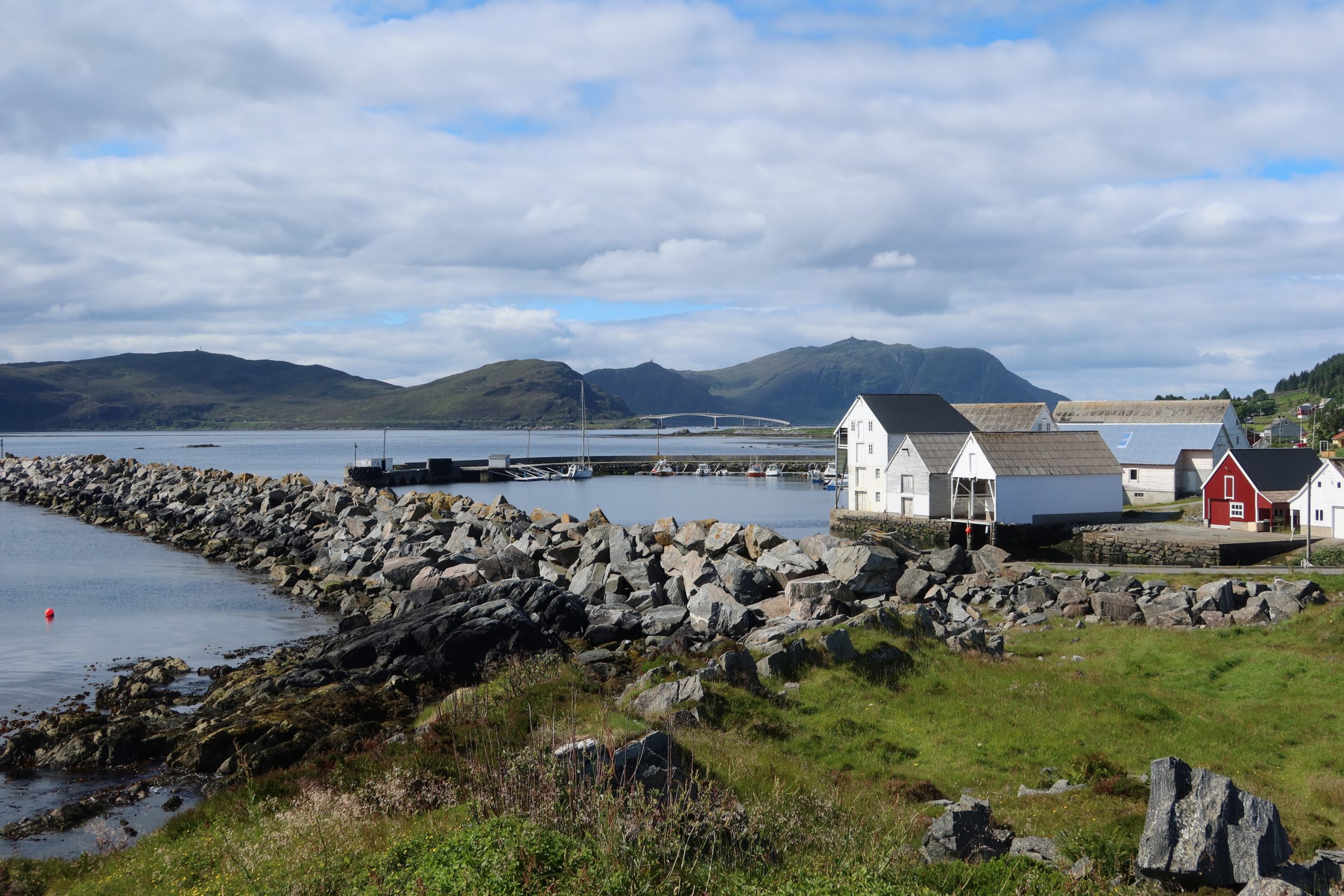
So, on to the walk which was the reason we set out. The starting point of the walk is a beautiful lake which you walk around and, like everything else around here, it turns out that this lake is connected with the fishery. The lake was created by damming the river and during the winter, the lake would freeze creating ice to be used in the fishery. The rest of the walk was just as beautiful following the stream past various waterfalls and up to the lakes above the village with a great view back to Å and Tind.


We then had one more day, much of which was spent shopping and cleaning and generally preparing the boat, but we still had time for another walk – this time around the southern peninsula and up to the radio mast – once again – a fantastic view of Å and Tind.

The next day, Hugh and Liz arrived mid-morning and we went for the walk up to the waterfalls once more, this time for Hugh to do some photos and seeing the results, I realised why I haven’t put my waterfall photos in this blog post!