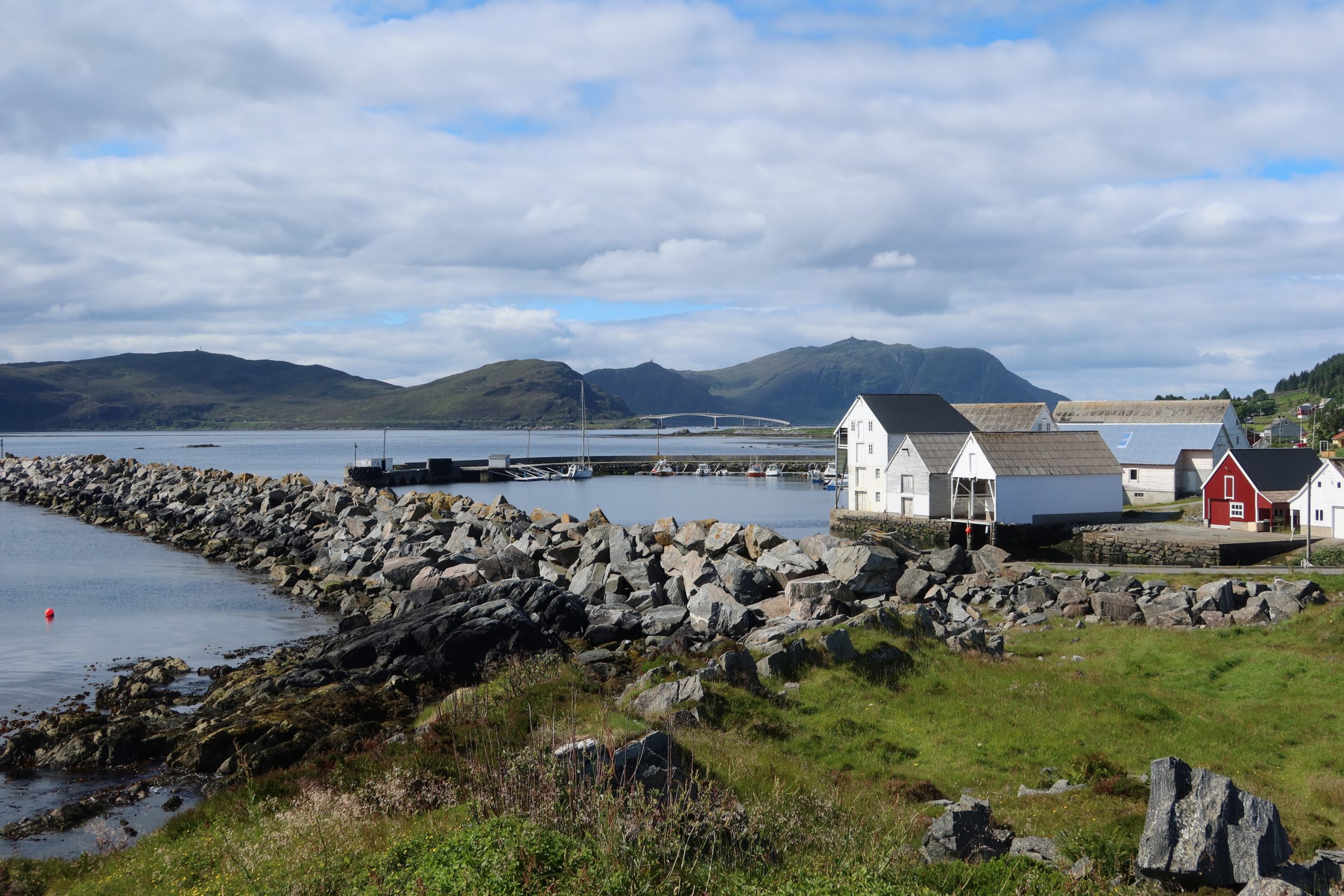
Another day, another passage …. This one was north (again) to Bodø – about 30 miles, so five and a half hours or so. Unfortunately (again) the wind wasn’t playing ball, so we ended up motoring much of it, but, as ever, this wasn’t much of a trial given the beautiful scenery around us. The final leg across to Bodø the wind did increase, but from straight ahead, so we just motored through it.
We timed our arrival immaculately, trying to enter the harbour at the same time as the Havila cruise ship. He was quite a lot bigger than us, so we let him go first! As we approached there were all sorts of works going on with pile-driving over the rocks and all sorts of infill and buildings being constructed. It turned out that this is a new airport and that they are moving the airport (which is virtually in the centre of town) to free up the land for housing and business development. Quite a project ….
We arrived early afternoon and, knowing we had a few days, started thinking about what we might do. One of the things on the Visit Bodø website was a Moose safari. Over all the years of travelling around Scandinavia, we have seen lots of moose warning signs on the road, become experts at recognising moose poo, but never actually seen a moose and with an offer saying that we wouldn’t have to pay if we didn’t see one, we decided to go for it. We had planned to book this some time in the coming days, but when we rang up, it turned out that there was one that evening with only one person on it, so it was going to be cancelled if we didn’t book. Subtle marketing pressure at its best, so we booked.
We met the guide (christened ‘moose man’) at a local hotel at 7pm. The moose apparently come out to play (well feed anyway!) in the evening, so no point in going any earlier. Once we had met the other lady (from Denmark) we headed off. Out of town we started heading off down various back roads and within about ten minutes spotted our first moose. The guide carefully parked up and our first impression was that they are big and ungainly. Their legs look almost out of proportion to their body, but the long legs could be considered an evolutionary trait to help them wade through deep snow – something they have to contend with for much of the year. It does though mean that in the deer attractiveness stakes they won’t be winning any prizes – they are the world’s tallest, largest and heaviest species of deer.
They are definitely big though – bull males can be up to 700kg in weight, and, while perhaps a little ungainly, can move very fast if startled. They can also swim to find aquatic plants or to escape predators, of which there are few. Wolves are the main predator and we were apparently not in an area with wolves, but in some areas bears and wolverines can predate on them. Around Bodø, this makes humans the main predator and so they are understandably nervous of us. Hunting is apparently strictly controlled and the licensing requirements even include a shooting accuracy test. That certainly counts me out ….. They are solitary animals and don’t move around in herds or packs. The calves will stay with their mothers for about 18 months, but are then abruptly chased off to make their own way in the world.

During the mating season in the autumn the subtle scent of testosterone pervades the atmosphere. (I just Googled it – apparently testosterone doesn’t have a scent, but I like the image that creates!) The males start thinking like males and showing off their antlers. The moose cows (female moose) are apparently impressed by antler size and symmetry and may select a mate on this basis. However, not before a fight, so the bulls will display and fight to be picked as a partner, hoping to impress a mate with the symmetry of their antlers, something I am sure we can all understand! The antlers take 3-5 months to grow and initially are covered with a velvet covering. This has extensive blood vessels in it which nourish the antler growth, but once they are mature, the velvet drops off and the moose will apparently eat this for the nutrients. Once the rutting season is done, the antlers themselves will drop off to conserve energy for the winter and the next spring, the process starts all over again. Around the age of thirteen though their time has come and the antlers start to shrink each season – a sure sign of age (apparently!). The one exception to all this is if a bull moose is accidentally castrated. How that might happen is perhaps something left in the recesses of the imagination, but, if it does, then the moose will grow a new set of misshapen and deformed antlers that last the rest of his life. These antlers will never be shed, marking him out for life.

As we moved around, we found more moose and at one stage, had a lovely encounter as the guide anticipated where they would go and parked up so that they walked across the road straight in front of us – we weren’t going to do any better than that. He kept hunting around for more, but that was the main encounter. He did also drive to an area where they had been reindeer (herded by the Sami people) on the previous evening, but they had moved on and he couldn’t find them. However, close encounters of the moose variety were sufficient.
On the way we stopped at Saltstraumen. This is renowned as the location of one of the fastest tidal currents in the world. Some accounts talk about tides of up to 20 knots, but this may be in the realms of fishermen’s stories. The more sober estimates from pilot books talk about a current of around 6-8 knots depending on conditions with the maximum northbound current being about four and a half hours after high water at Bodø. The phenomenon comes about because of the narrow channel connecting the outer Saltfjorden to the larger Skjerstad Fjord. The tide rushes through this gap between the islands of Straumøya and Knaplundsøya. The difference between the sea level and the fjord inside can be up to a metre and so the tide hurtles through the gap trying to fill (or empty) the fjord. Whatever the cause, it was impressive. It is also a magnet for fishermen due to an abundance of fish. The various species fished for include saithe, cod, wolffish, rose fish, and halibut. Coalfish is a particular specialty of the area.

For the rest of our time in Bodø we pottered around. We caught up on shopping, washing, cleaning but also found time to explore and wander around a little. We did try and visit the various museums, but a holiday weekend is rigidly observed here and they were all firmly shut! We did manage a concert though. While wandering around we dropped in to the concert hall on the off chance there was a concert and with immaculate timing, there was one the next evening. Tickets bought, we headed back the next evening to a fascinating programme termed ‘Beyond Haydn’. The concert was by the Arctic Philharmonic orchestra and the first half was pieces which have been inspired by or mimic or perhaps emulate the work of Haydn. The name of the first piece was Meine kleine Haydn Musik and was by Henryk Czyż. This was followed by Arnold Bax’s Romantic Overture. Both these made for fascinating listening. The link between Haydn and the final piece in the first half by Anton Webern seemed more convoluted. It was (thankfully?) a short piece entitles Concerto and it lacked the tonality of the previous pieces, but it was argued that it had a classical precision in the way the music was built, emulating the precise style of Haydn. I am still struggling to see (or hear!) that, but, each to their own …… The second half was then Haydn’s Symphony 90 and was played in an exuberant, enthusiastic and joyful way. A lovely finish to an intriguing concert. Sitting around tables watching, in a jazz club style, just added to the atmosphere.
An intriguing few days in Bodø sampling some of the culture of a city which was a European Capital of Culture in 2024 – a culture which extends to football, something which is very important in Bodø. The club plays in the Norwegian equivalent of the premier league and the proliferation of yellow flags around the town attests to the local support.