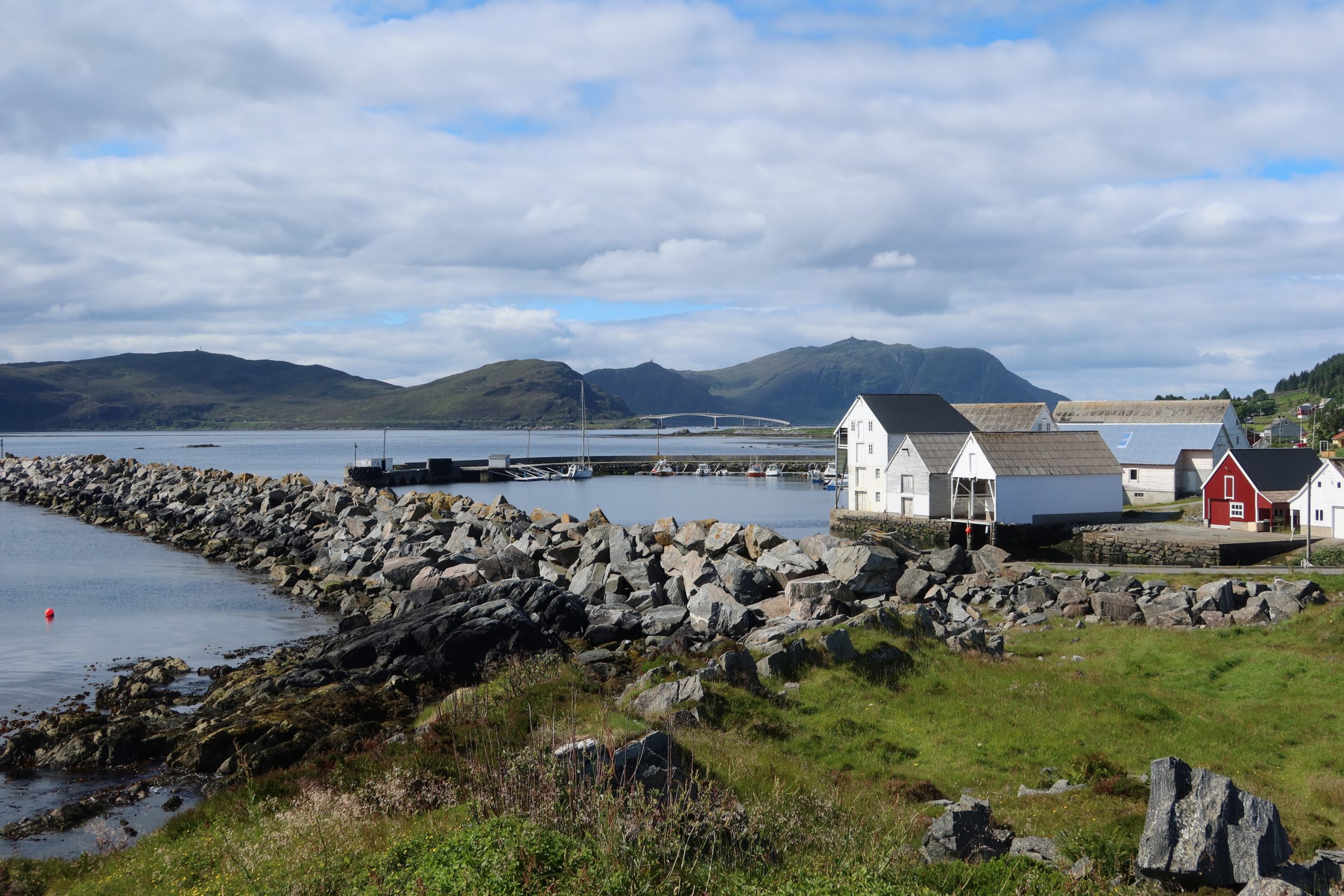
With settled weather forecast for a couple of days we decided to try and make some progress north. We had originally planned to try and stop at a few places between Kuringvågen and Rørvik, but with a storm coming through in a few days, we decided to make the most of the settled weather and take the outside sea route rather than sneak between the islands. This meant a 60 mile plus leg, so, an early start was in order. We planned to leave at 6am and left at 06.05, so that was a result ….
As we headed out we were faced with a nice sailing breeze, but in this part of the world, nice sailing breezes can be very localised, sometimes just the air dropping down the hills or being funnelled through gaps. Nevertheless with some gusts up to around 18 knots we had some lovely sailing under staysail only making good progress for an hour or so. Then we switched the staysail to the genoa and that lasted a whole 9 minutes before we switched again – this time to the engine! From there on we had a few hours of playing sail roulette – some main and staysail and sometimes main and genoa and sometimes engine and main. That game ended at 11.25 and then engine then went on for the rest of the trip as the wind just decided to take a complete holiday. Still, through all of this, we were with Ruby Tuesday in company and managed to get some nice photos of her sailing.


Just after 5pm we headed under the bridge at Rørvik and spotted some large black shapes in the water. We quickly realised that they were whales and we just drifted for the next 20 minutes or so while we watched their antics. We reckoned that they were long-finned pilot whales and they seemed to be in about three groups – possibly fishing as they were diving regularly. The odds seemed to be that they were all part of one group as they are apparently very social animals and can travel in groups of between 20 and 150 individuals. With constant diving and surfacing they were difficult to count, but we certainly thought that there could have been a group of at least 20 of them. The name apparently derives from the ancient belief that there was a single individual in any pod who was the ‘lead’ or ‘pilot’ whale, though some sailors take the slightly more pragmatic approach of calling them ‘pothead whales‘ not because of their social smoking habits, but because the shape of the head reminded the sailors of cooking pots!
The name is of course a misnomer as they are dolphins and not whales. Like Orcas and some other small whales they actually belong to the cetacean family, but are dolphins, not that you are going to debate that with them if you come face to face with them – they range from 6-8 metres when fully grown. The males are usually up to 2 metres longer than the females, making them the second-largest member of the dolphin family. They are also the species most prone to mass strandings. The largest ever documented stranding was of 1,000 whales on the Chatham Islands (to the east of New Zealand) in 1918, but as recently as 2017 600 pilot whales were stranded at Farewell Spit in New Zealand – the second-largest documented stranding. It was great to see them, though we did want to have a chat with them and suggest that hanging around in Norwegian waters may not be the best move, given that Norway, along with Japan and Russia lodged formal objections to the International Whaling Commission, allowing them still to hunt whales. However, they apparently only hunt Minke whales, something this pod of pilot whales were perhaps well aware of.


Rørvik itself was a nice small town. The guest jetties (with room for only a few boats) were handy for shopping and fuel, so we took the chance to stock up a bit. On the way back from the supermarket we walked across an old bridge over the neighbouring inlet to see what all the noise was about. It turned out to be a whole nesting site for black-legged kittiwakes. I had seen these last season at Grip (an offshore island) but they are increasingly moving into urban areas as climate change means that their traditional feeding grounds are under threat. As a species they were first described by Carl Linnaeus in his landmark 1758 10th edition of Systema Naturae as Larus tridactylus. We apparently call them kittiwakes from the call they make – a shrill ‘kittee-wa-aaake, kitte-wa-aaake‘.
Watching them for a while, what we particularly enjoyed was their optimism and persistence. On some of the old jetty buildings there were quite steep sills, but this was not going to stop them trying to nest there. They would fly onto the sill, keep flapping their wings while trying to start nest-building and when they failed, just go round and start again – the very definition of determination. Or perhaps a Darwinian reflection of a lack of knowledge of physics …..
With the black-legged kittiwake on Norway’s red-list as an endangered species, let’s hope that this adoption of urban environments proves to be a successful one for them.