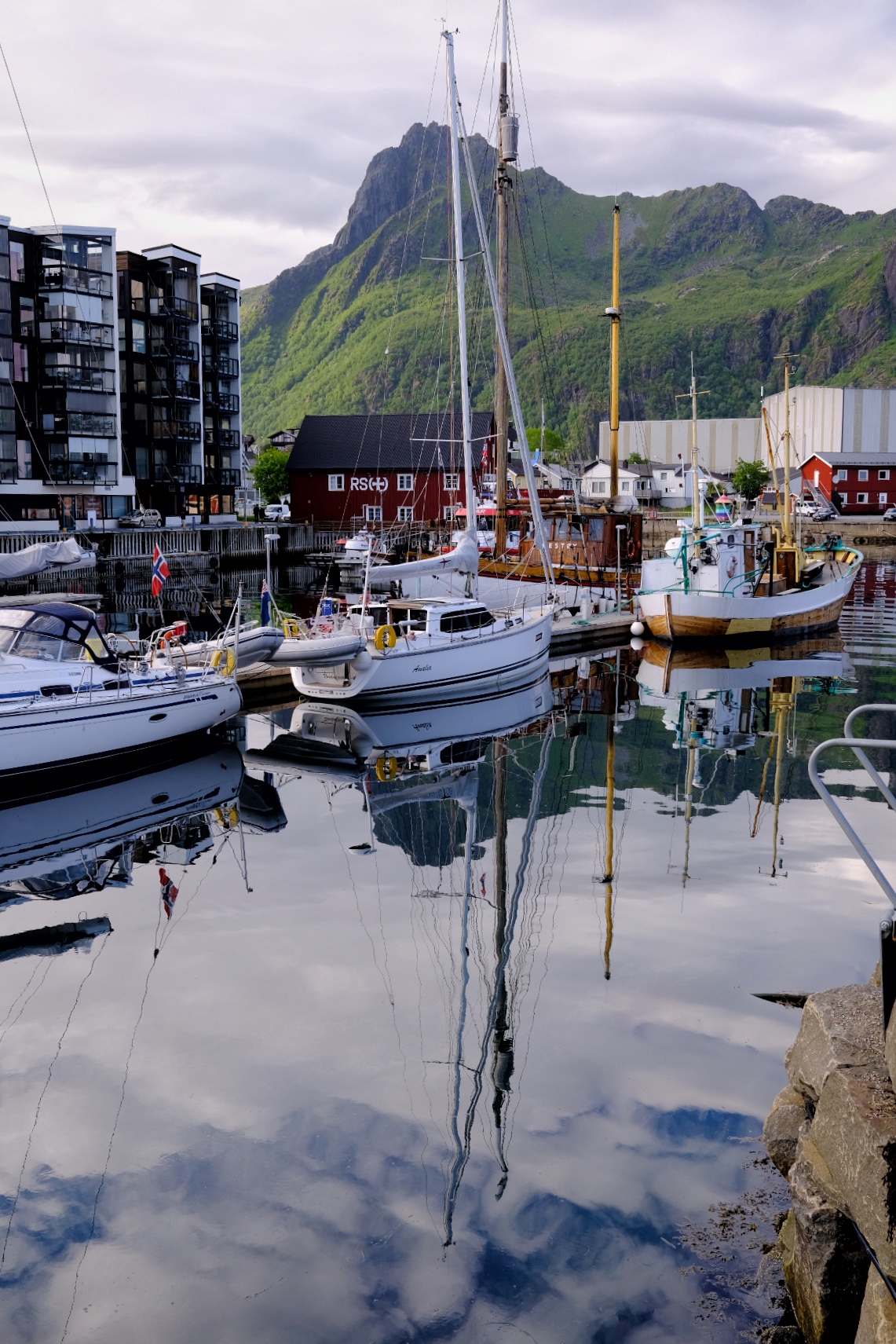

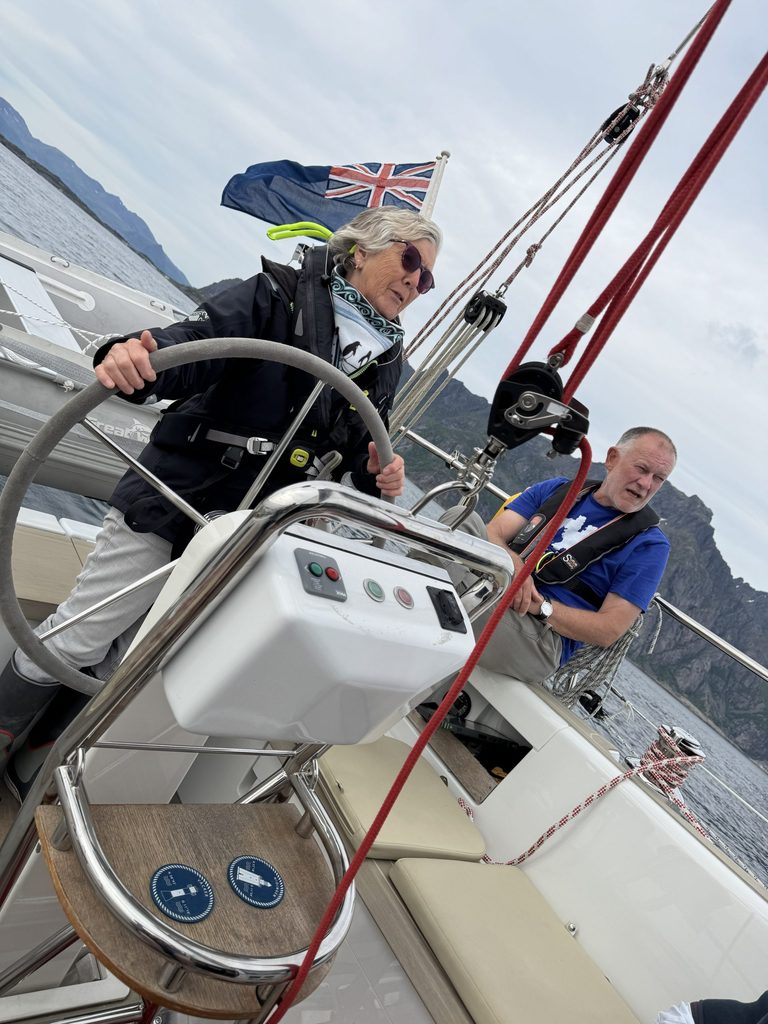
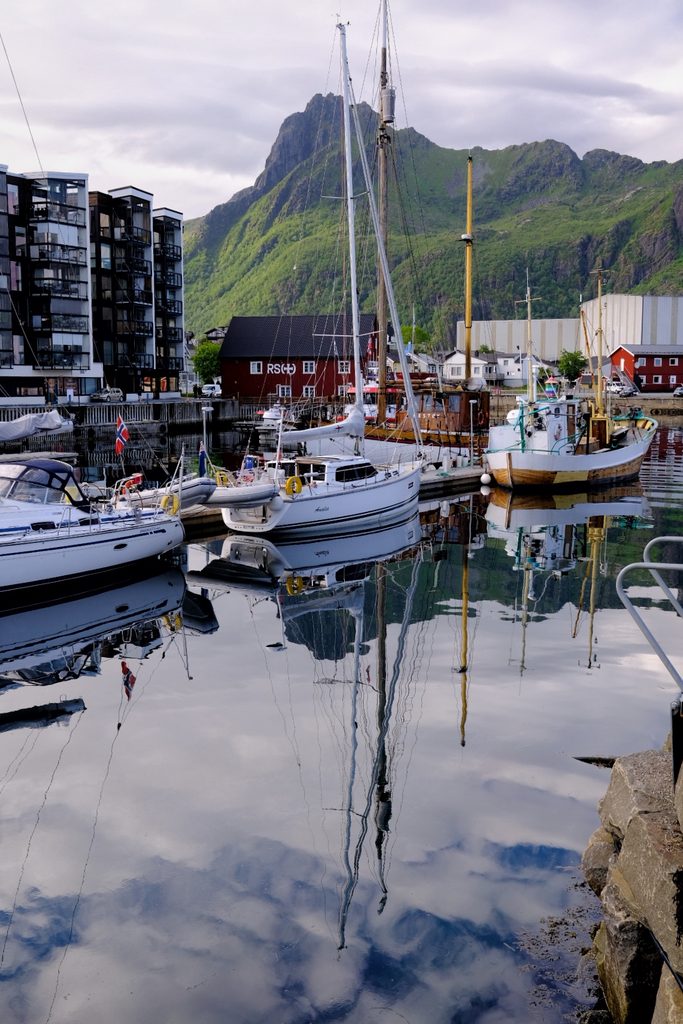
After lunch in Henningsvær we headed off to Svolvær. A nice short sail and the wind slowly died, but we managed to sail a fair chunk of it, mooring just before 5pm in front of Hekla. The other two boats had headed just down the coast to Kabelvåg, but both Hekla and us felt the siren call of washing facilities to be too great, so on arrival headed straight across to the service building to dominate their bank of two whole washing machines!
The next day we pottered around Svolvær finding a woolshop for some essentials (wool!) and a branch of Clas Ohlson for some non-essentials (toothbrush heads and a sink plunger – not an essential until it is an essential!). Hugh and Liz headed off to the WWII museum as did some of the other boats.
After lunch we took the bus over to Kabelvåg to have a look round. We got off at the cathedral bus stop to check that out. The cathedral just feels like something completely out of context, but this view is a modern one. It is otherwise known as Vågan Church, but locally as Lofoten Cathedral. You can immediately see why. It completely dominates the landscape (and in Lofoten that is quite an achievement) and, while the current church dates from 1898, there has been a church here for centuries. Fishermen would prepare themselves for the Lofoten Fishery with a visit to the church and congregations of over 1,000 were not uncommon as people sought the blessing of a higher authority for their safety and success while fishing. In fact it was a resolution from 1895 by the Crown Prince which stated that the parish church should accommodate one-third of the parish’s inhabitants at any given time. With 6,000 people in Vågan parish during the fishery the church should have been even larger, but they were given an exemption because of seasonal variations in the number of parishioners.
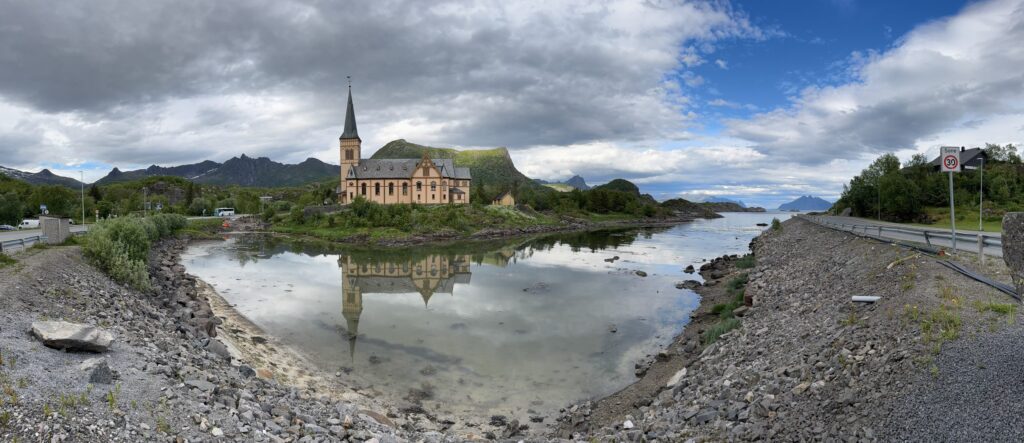
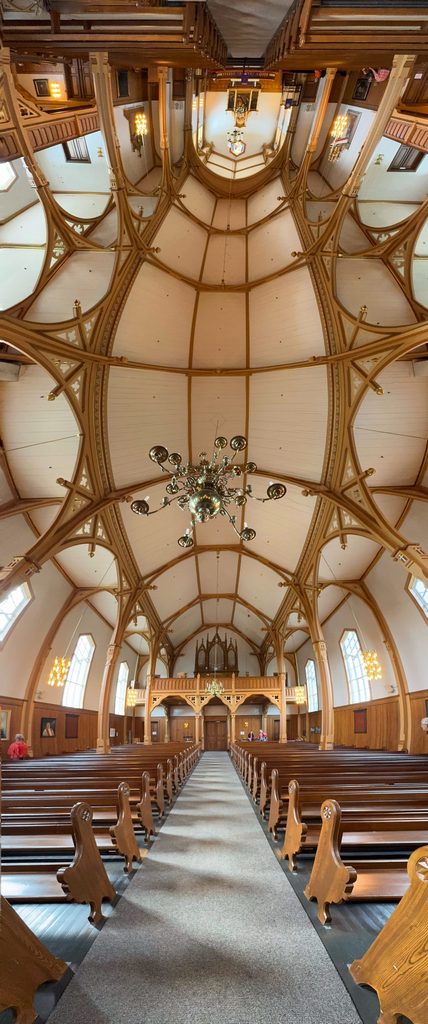
The first church on the site though was from the 12th century and over time there have been five or six different churches. In fact one has even been moved to the island of Værøy, but the scale of the current church makes it the largest wooden building in northern Norway. The plans were drawn up by the architect Carl J. Bergstrøm and it was finally built in 1898 in a cruciform style.
Outside the cathedral/church is a statue of Hans Poulson Egede. He became known as the Apostle of Greenland after establishing a successful mission amongst the Inuit people in Greenland. He also founded Greenland’s capital Godthåb, which is now known as Nuuk. It was when he was in Lofoten he heard about the old Norse settlements on Greenland. Contact had been lost with them centuries before and he sought permission from Frederick IV of Denmark-Norway to try and rekindle the contact. He established the Bergen Greenland Company (Det Bergen Grønlandske Compagnie) with money from merchants in Bergen and a smaller amount from Frederick IV. They set off on three ships with 40 colonists though most left by the end of the first winter – many of them struck down by scurvy. However, Egede stuck it out and he even learnt the language of the local Kalaallit people. One story around him concerns his attempts to translate the phrase from the Lord’s Prayer – ‘… give us this day our daily bread …’. This apparently, unsurprisingly in Greenland became ‘… give us this day our daily seal …’. Somehow seems more appropriate to me, but theologians might disagree!
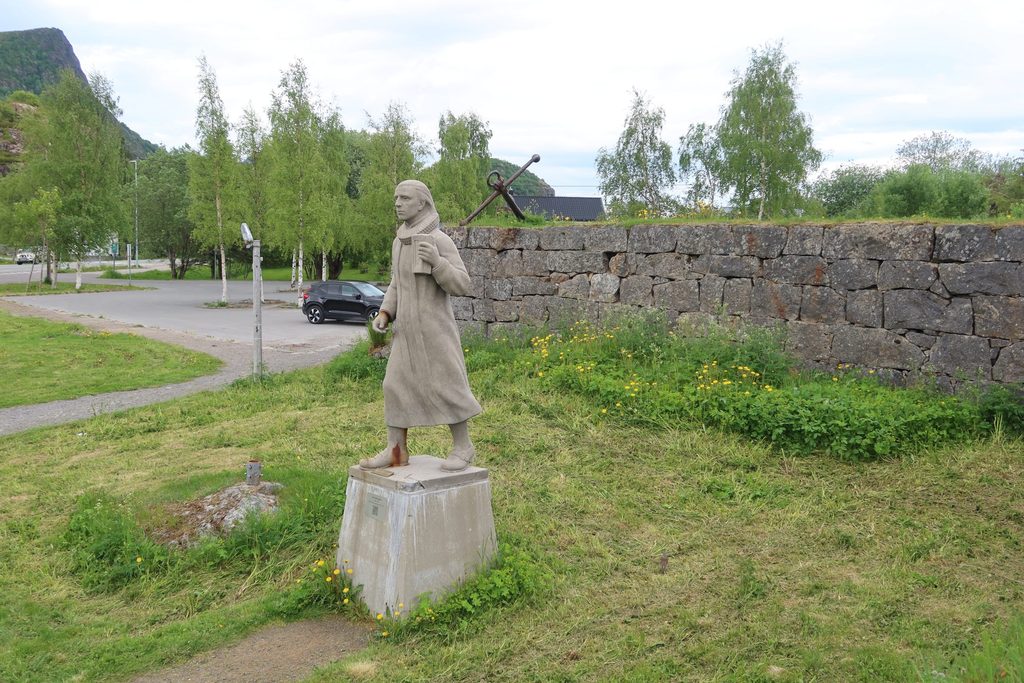
His notoriety has spread and he holds the legacy of a national “saint” of Greenland, there is a crater on the moon named after him, something I am sure we all aspire to! There are also a number of statues of him – one in Nuuk, one outside Frederik’s Church (Marmorkirken) in Copenhagen (which was spray-painted with the word “decolonise” in 2020) and of course one outside the Lofoten Cathedral. As a sailor though, I would have to argue that his greatest claim to fame came with him giving the first written description of a giant squid – well he described it as a sea serpent, but it was almost certainly a giant squid. In 1734 he wrote:
We saw a most terrible creature, resembling nothing they saw before. The monster lifted its head so high that it seemed to be higher than the crow’s nest on the mainmast. The head was small and the body short and wrinkled. The unknown creature was using giant fins which propelled it through the water. Later the sailors saw its tail as well. The monster was longer than our whole ship.
Hans Egede (1734)
From the cathedral we walked down into town to look around, though having had our religious sustenance we needed more tangible sustenance, handily provided by an organic coffee shop with particularly tempting pastries and snacks. We actually ended up sitting around there for quite a time as we also met Ian and Uli (from Ruby Tuesday) who had stayed in town to walk and fish, so we passed the time of day with them until everyone got back from Svolvær and Hekla arrived. Drinks and a sociable supper on Aloucia followed and we found ourselves catching the last bus back to Svolvær.