
A guest blog entry from our crew – Hugh Rayment-Pickard:
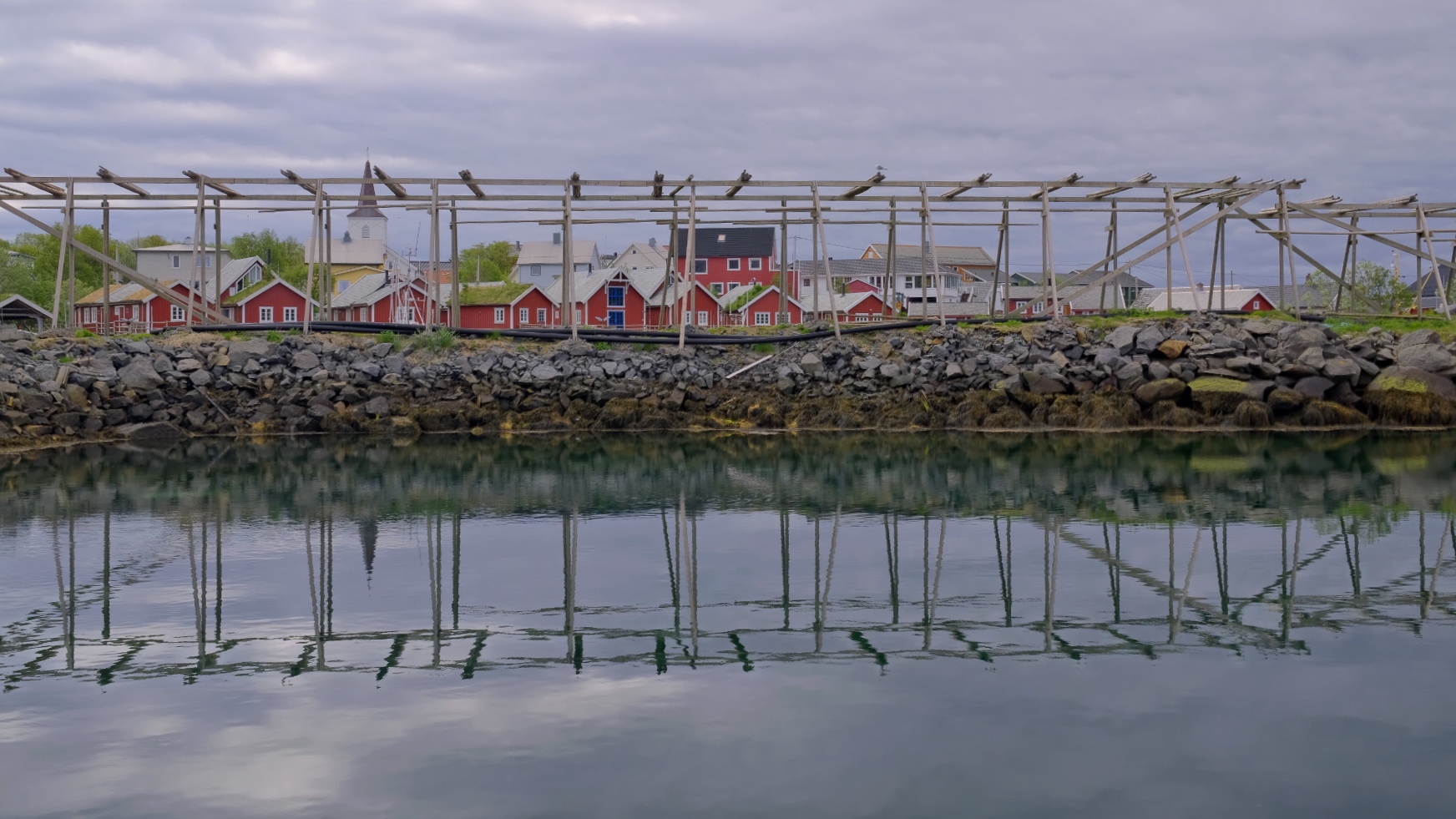
If you visit the Lofoten islands, you can’t miss the sight and smell of dried fish or stockfish. The fish- usually cod – is beheaded, gutted and flattened, then dried without salt in wind and sun for three months before maturing indoors. What remains has lost 80% of its moisture, becoming a light, durable sheet of protein that can last for five years. The rehydration of the rigid panels of fish – which look more like wood than food – can take up to seven days’ soaking in cold water.
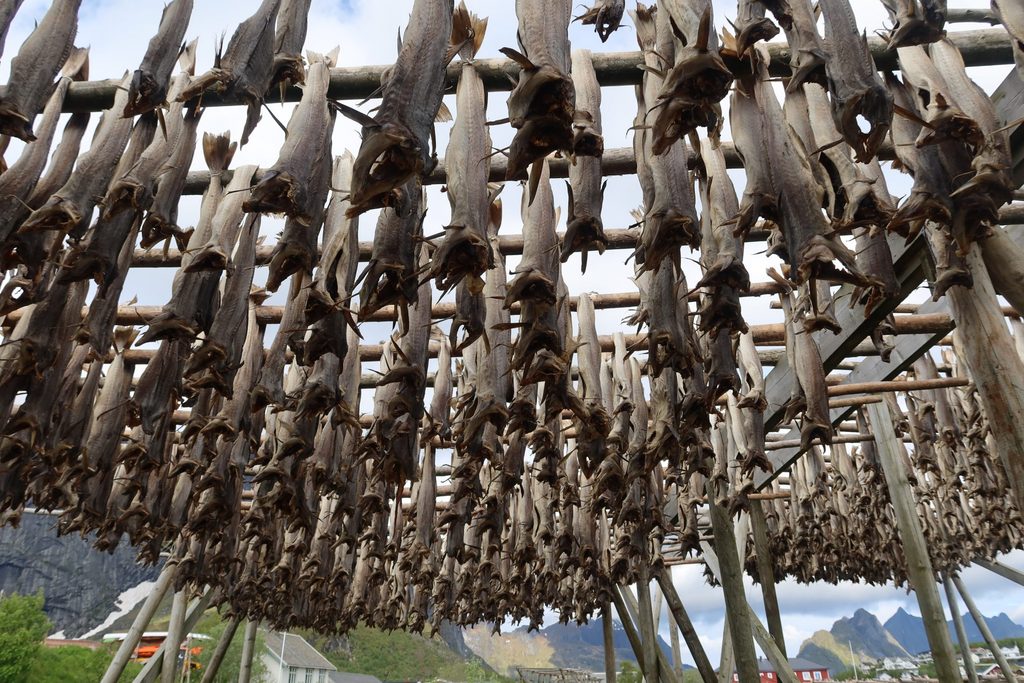
Archaeological evidence suggests this voyage-ready food was a staple for the Vikings. But preserving fish in the cold Arctic wind almost certainly goes back much earlier, perhaps even to pre-historic times.
The presence of fish in Norway should come as no surprise. But what is surprising is that 90% of Lofoten’s premium stockfish each year is not eaten in Svolvær or Moskenes but is exported to just one country: Italy.
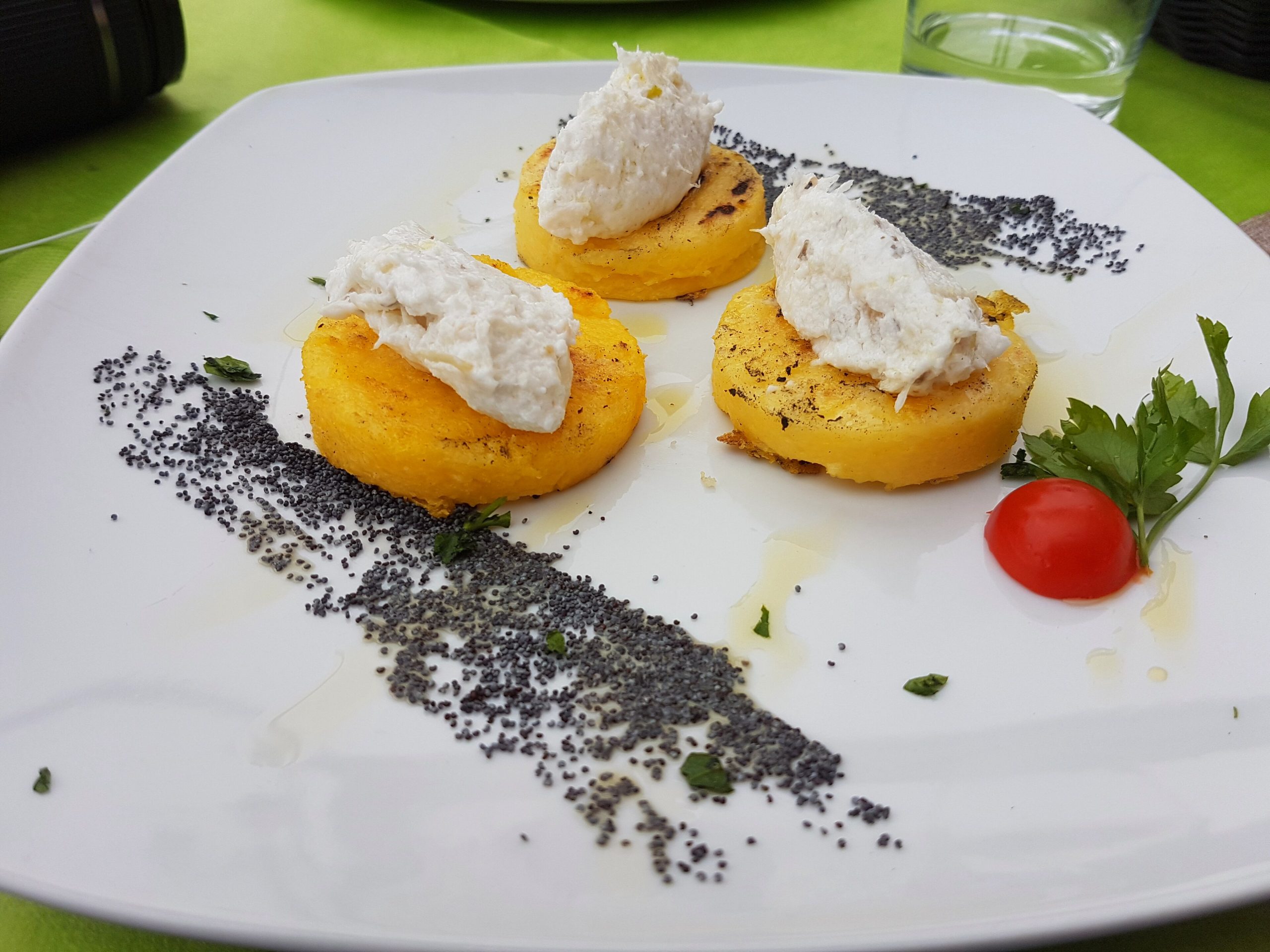
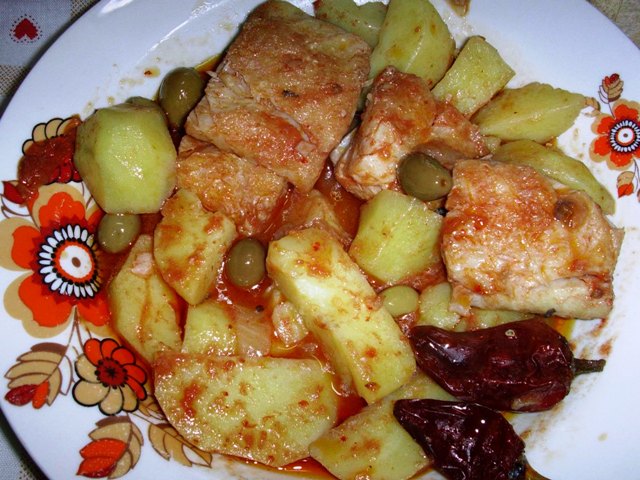
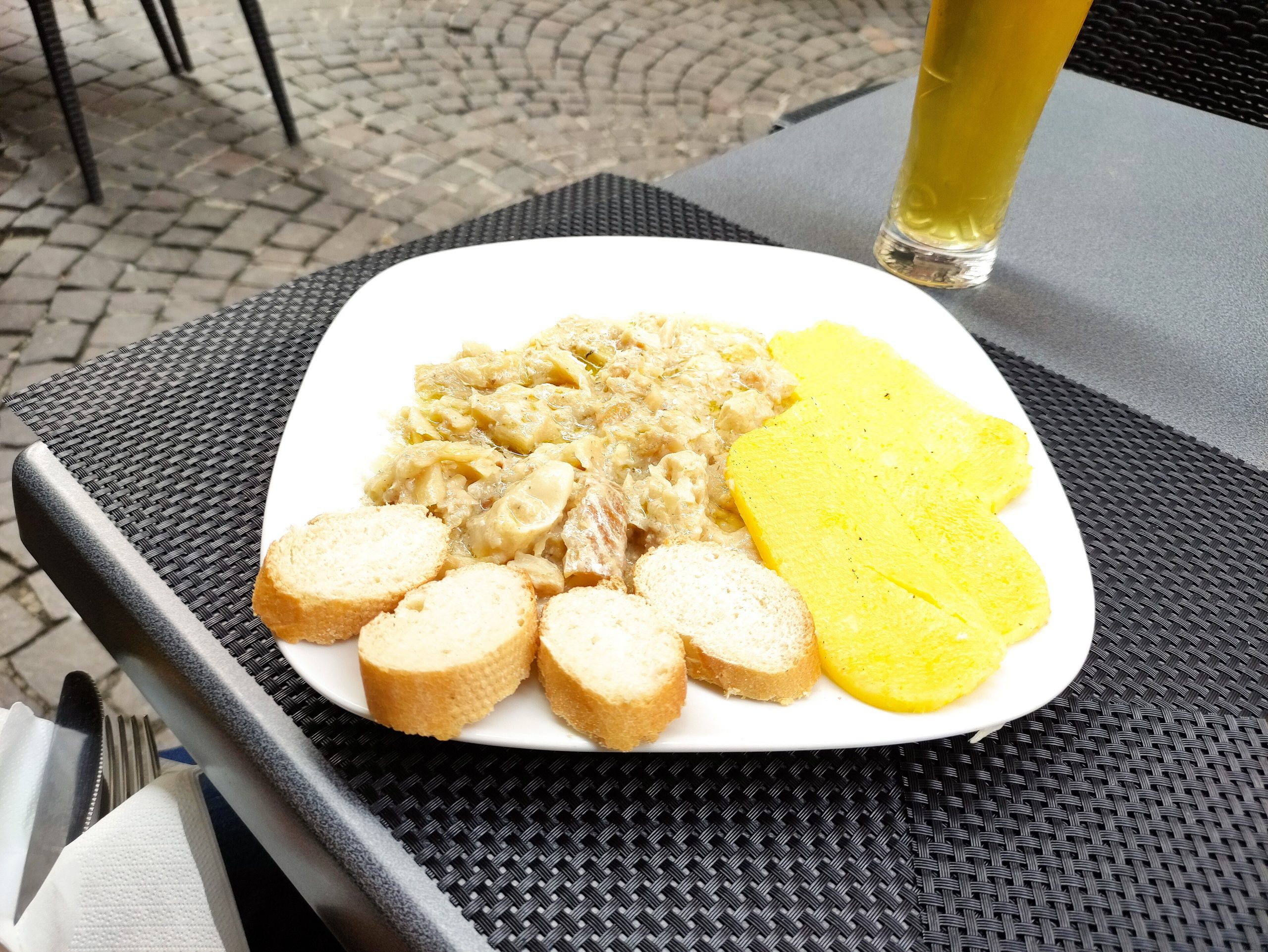
For six hundred years Italians have been the principal consumers of dried stockfish from Lofoten with Italian cooks turning this unpromising foodstuff into a range of delicious dishes: Stocco di Mammola is a traditional Calabrian dish made with potatoes and rehydrated stock fish. tomatoes, black olives and chili. Stoccafisso Accomodato is a classic Genovese recipe with pinenuts and olives. Baccalà Mantecato from Venice is a creamy puree of stock fish olive oil and lemon.
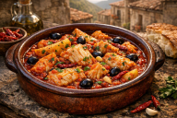
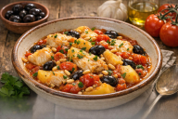
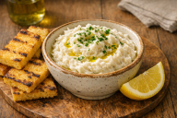
The history of Italy’s culinary romance with stockfish can be traced very precisely to the Island of Crete on Wednesday 25 April 1431. Pietro Querini, a Venetian nobleman and merchant, was preparing to set sail to the low countries aboard the Italian ship the Cocca Querina, carrying a cargo including Malvasia wine (malmsey), olive oil, raisins and cotton. The plan for the return journey was probably to bring woolen cloth back to Italy.
The Cocco Querina was transporting a floating fortune. At a cautious estimate the cargo was worth hundreds of thousands of ducats, the equivalent of several million pounds in today’s money. This was not a bulk ‘cheap goods’ operation, but a premium long-distance merchant venture, targeted at one of Europe’s richest markets. The stakes were high, but so were the potential rewards.
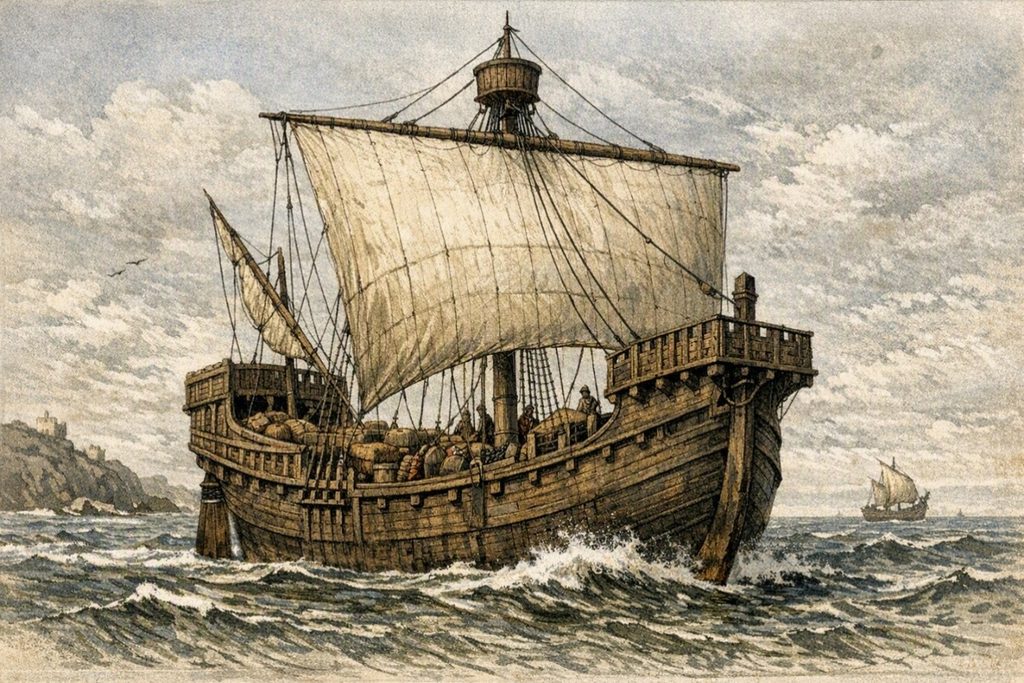
The risks to the operation were all at sea. The Cocca Querina was an ocean-capable vessel but vulnerable: Ships of this kind could handle long voyages beyond the Mediterranean, but this was not a nimble vessel. With its broad hull and square sail, the Querina could run well before the wind but made very poor progress to windward. Persistent headwinds could force it to wait, tack laboriously across a wide angle, or be driven far off course. Rudder failure could be disastrous.
Because of these risks, the standard (and safe) method of transporting cargo by sea was to use oared galleys, which could be chartered from the Venetian government. An oared galley carried 150 tons and required a crew of 250. By comparison the Cocco Querina could take a payload of 420 tons with a crew of just 68. Do the math, as they say.
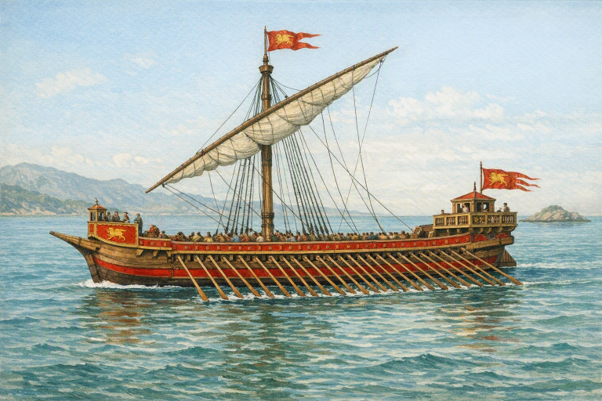
Taking a square-rigged vessel on this mission was a massive gamble – and Pietro and his crew would have known it. Pietro must have promised his crew handsome remuneration to participate in this hazardous venture. Had Pietro used an oared galley, success would have been a near certainty, and 57 lives would have been saved. But his profits would have been a fraction of those projected in his scheme.
We do not know much about Pietro’s sailing experience, particularly in the Atlantic, but it seems likely to have been minimal. Senior members of his crew paint a picture of him as a posh boy ‘used to refined living’, of ‘very delicate complexion’ with a ‘soft, weak body’ yet to be hardened by real experience at sea. The Cocca Querina may also have been a new boat that had barely ventured outside the Mediterranean.
Pietro believed that God was on his side. Throughout the voyage we see how his faith was central to his leadership and psychology, seeing every setback as part of God’s greater plan. With enough prayer and petition, Pietro believed that God would ensure a successful voyage.
Pietro’s journey was beset by disaster before it had even started. Five days before the Cocca Querina set sail, Pietro’s teenage son died. The loss was devastating. His son was due to sail with him and Pietro said that grief ‘invaded every sinew of my body. I felt alone and bereft of any consolation… I believed I had been wronged by God.’
Six weeks into the voyage, on June 2, the rudder broke, forcing the Cocca Querina to dock in Cadiz. The ship was breached in three places on the keel, and the crew had to bail furiously to keep the ship dry. The crew improvised repairs to the rudder using hemp rope. On leaving Cadiz, strong headwinds drove the ship 700 nautical miles off course to the Canary Islands, before reaching Lisbon in late August, where repairs were necessary to reinforce the vessel and replenish supplies. The passage would normally have taken four to six weeks. The Querina had taken eighteen.
It’s a sign of Pietro’s desperation that at this point he turned to God for assistance. In October the Cocca Querina made an unforced stop at the Spanish port of Muros. According to Querini’s own account, he travelled two to three days inland to Santiago de Compostela, where they visited the shrine of St James in the great medieval cathedral.
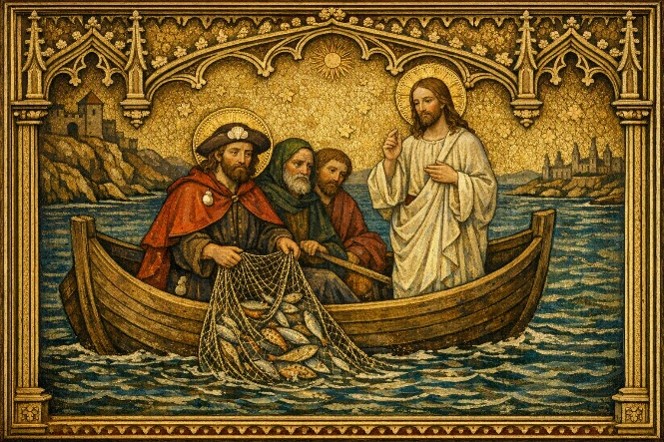
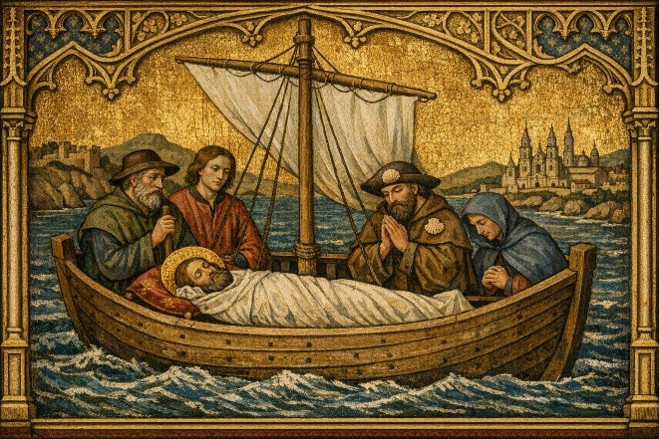
What did Pietro do at the cathedral? He would probably have attended mass and knelt in private prayer before the shrine of St James, asking for protection, safe passage, favourable winds, and deliverance from further disaster. One thing he surely did was to pray for the soul of his dead son.
Pietro may well have known the medieval hymn Ave maris stella – ‘Hail, Star of the Sea’ – with its prayer that the Virgin should iter para tutum, ‘prepare a safe way’. Safe passage for his ship certainly, but perhaps also safe passage for his son on his journey beyond this life.
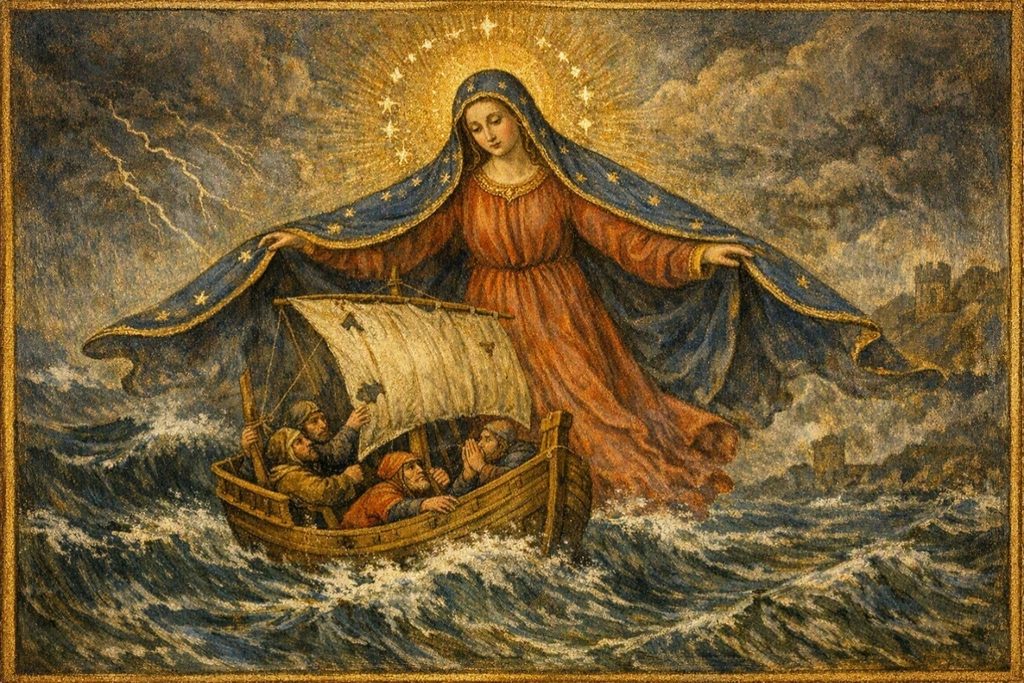
On 5 November 1431, the Cocco Querina set sail once more. The Virgin Mary clearly hadn’t been listening because violent storms pushed the ship toward the Scilly Islands, and then further north around the Atlantic coast of Ireland. They were now well out of sight or land or likely rescue.
Around 10 November the rudder’s pintles and gudgeons (the hinge system that holds the rudder onto the back of a ship) broke rendering it useless. They tried to implement another repair, but the rough seas knocked the rudder completely off its hinges although it remained attached by a cable to the stern. For three days they dragged the ineffective rudder behind them before hauling it on board. But without the rudder, they were directionless: ‘In this way we were driven hither and thither in the manner and in the direction imposed on us by the storm, taking us ever further from land.’ Pietro imposed rationing to preserve the lives of the crew.
Apparently abandoned by his God, Pietro was now suffering a mental and spiritual crisis. It’s a measure of his tortured state of mind that he found psychological relief in the thought that his son was dead and no longer on board: ‘My heart would most certainly have broken every hour had I seen him there, knowing that he was going to die before my eyes.’
Once again, he knelt in prayer: ‘seeing that there was nothing else to be done, I retreated alone into my small quarters with great bitterness of spirit and, reflecting on the piteous situation I was in, turned my heart to God, commending myself to Him and repenting of my sins.’
Suddenly he realised that his own prayers may not be enough and gathered the crew together on deck and in an impassioned speech, with his voice breaking and in tears, he asked them to join in collective prayer and repent of their misdeeds: ‘Repent of all your sins and commend yourselves to his pity, so that when the hour comes when we must leave this pitiful and afflicted life, his Majesty will receive us on our passage into his benign and compassionate arms.’
Surprisingly, this doom-laden pep-talk seems to have raised morale, and with renewed optimism the crew improvised a jury rig: a makeshift arrangement of spars, rope and canvas, assembled from whatever remained usable, in the hope of giving the crippled ship some command over wind and sea. The sailors looked with pride at their handiwork and perhaps thought briefly that God had indeed heard their prayers. Moments later the wind hardened and the carefully assembled rig was ripped away by the waves.
From the high sterncastle, Pietro could survey the broad cargo vessel and with clarity see both the wreckage and their desperate predicament. He no longer had command of the destiny of his ship. His crew were broken and on the edge of despair. Notwithstanding, Pietro’s faith was undimmed, and he led the crew in a further tearful and frantic session of prayer.
The helmsman and boatswain, the cook, clerks and carpenter, the sailmaker and ordinary mariners – all screamed their petitions to the Virgin Mary and every other saint they could think of, begging them to placate God and come to their aid. Crew members shouted promises to God, that if saved they would perform pilgrimages and acts of charity. The whole ship’s company was now convinced of one thing: they were going to die … unless God intervened. The cacophony of pleading voices must have been chilling to hear.
But apparently, according to Pietro, God did hear their prayers because the wind abated. ‘This had a marvellous effect, because despite the furious sea we were saved from death.’ The wind had eased, but the sea had not: Atlantic swell continued to roll beneath the hull, lifting her and dropping her heavily, working her timbers with every rise and fall.
By now, both the principal sail and the reserve sail were shot. The crew took depth soundings and found that they were in 60 metres of water with a gravel bed. Joining several cables together they improvised an anchor, which provided some stability for a couple of days. But their efforts to stablise the boat were jinxed. At night one crewman, whether from fear, exhaustion or desperation, cut the anchor warp. They were back where they started.
The boat was sat very low in the water and the crew had for several days been standing up to their waists, bailing continuously – an exhausting Sisyphean task, because the ship would fill almost as fast as they emptied it. To lose weight and lift the boat out of the water, Pietro decided to fell the mast and toss it overboard.
At this desperate juncture, it is telling that Pietro preferred to lose the mast rather than jettison cargo. The businessman in him must have still hoped that somehow God would steer them to safety so that they could land their goods, collect their profits and return to Venice covered in glory.
For a 15th‑century sailing vessel, throwing cargo overboard was standard procedure in a serious emergency. To a dedicated seaman the choice would have been obvious: cargo could be sacrificed, lives should not. Deck cargo should have been jettisoned the minute steerage was lost. By the time the boat was sitting low in the water, throwing heavy cargo overboard should have been a priority. But Pietro was thinking like a merchant not a mariner.
With the mast gone, the ship lost both stability and lift, began to list badly, and shipped more water with every roll. Pietro estimated that the Cocco Querina was 700 nautical miles from land – without either sails or steering. His crew had given up hope. Several had cracked open the casks of wine and were drinking themselves into oblivion, sat all day warming themselves by a fire, which they made from the ship’s scented cypress wood. Pietro also looked for spiritual consolation, but of a different kind: ‘As the nights descended and stretched endlessly before us, we had the custom … of repairing to my cabin and calling upon the Virgin, our Empress. We used to pray in tears, in the most pious words, both to her and her omnipotent son, our redeemer, to save us from so much force and fury and darkness.’
We must remember that this was a merchant and not a military vessel. The crew were not subject to naval discipline. Leadership of the ship’s company – which, alongside the crew included office assistants, business partners and hired marines – must have required considerable persuasion. Medieval maritime custom certainly gave a shipmaster authority, but a merchant ship was a negotiated community, not a barracks.
Eventually Pietro let go of the fantasy of divine rescue and took the inevitable decision to abandon the crippled Cocco Querina and continue in the secondary vessels. 21 crew volunteered to go in the skiff and the remaining 47 in the larger boat. At daybreak on the 17 of December they left the Querina to sink to the bottom of the Atlantic, and with it Pietro’s cargo and his dreams of honour and riches: ‘Thus we departed at dawn of that day, leaving the unhappy ship, which I had built with such endeavour, and such delight, and in which I had placed the highest hopes. We left behind eight hundred barrels of malvasia wine, much scented and worked cypress wood, pepper and ginger which were of no small value, along with a lot of other fine merchandise.’
Of the fate of the 21 crew in the skiff, we know only this: They lost contact in the terrible weather and perished.
In the larger boat, where Pietro was sat, their fate was only slightly better. The weather was freezing and the damaged boat was leaking. The cold seeped into them – through wet clothes, numb fingers, and weak limbs. The crew were bailing and helming 24/7 on rotation. They had ditched most of their cargo and were down to essential supplies. Pietro said that enfeebled crew members were literally dropping dead before their eyes: first the alcoholics (who were still intoxicated) then the weak and injured.
After ten days and the deaths of half the crew, the wine ran out, leaving them without hydration. In desperation, the surviving mariners were drinking seawater and urine. They continued in this way for five days. This was a war of attrition – with starvation and the weather battering their wracked bodies.
It is hard fully to imagine Pietro’s emotional reaction to what happened next. With the crew now on the verge of death and floating aimlessly and without hope, having lost three quarters of their fellow crew members, on January 4, 1432, the survivors sighted land. Rowing towards the shore by day and using a compass bearing by night, using whatever winds they could, they progressed over two days to the southernmost of the Lofoten Islands.
But they were not safe yet. The wind was behind them and Pietro faced what one poet has called ‘the impervious horrors of a leeward shore’. As the vessel closed on the coast, Pietro could only see rocks in all directions: ‘as we neared the rock of our salvation, there was not a single beach along its shore to be found upon which we could safely land.’ Having made it this far, they faced the prospect of having their vessel and its crew shattered on the craggy shoreline.
Thankfully, a small beach came into view: ‘It happened, by a great miracle, that our guide and saviour led us to the only little beach that there was, depositing us there tired and exhausted, like weary birds landing after migration.’ The shore was covered in snow and Petro fell to his knees and pushed the snow into his mouth as fast as he could: ‘It seemed to me that my entire health and happiness consisted in consuming that snow.’
It was too late for some: five crew members died that night. There were just 16 of them left, all infested with lice. One of Pietro’s clerks had so many lice on his neck they had eaten away the flesh to reveal the nerves. Most were too weak to get up and over the coming days, they sustained themselves with sea snails and barnacles.
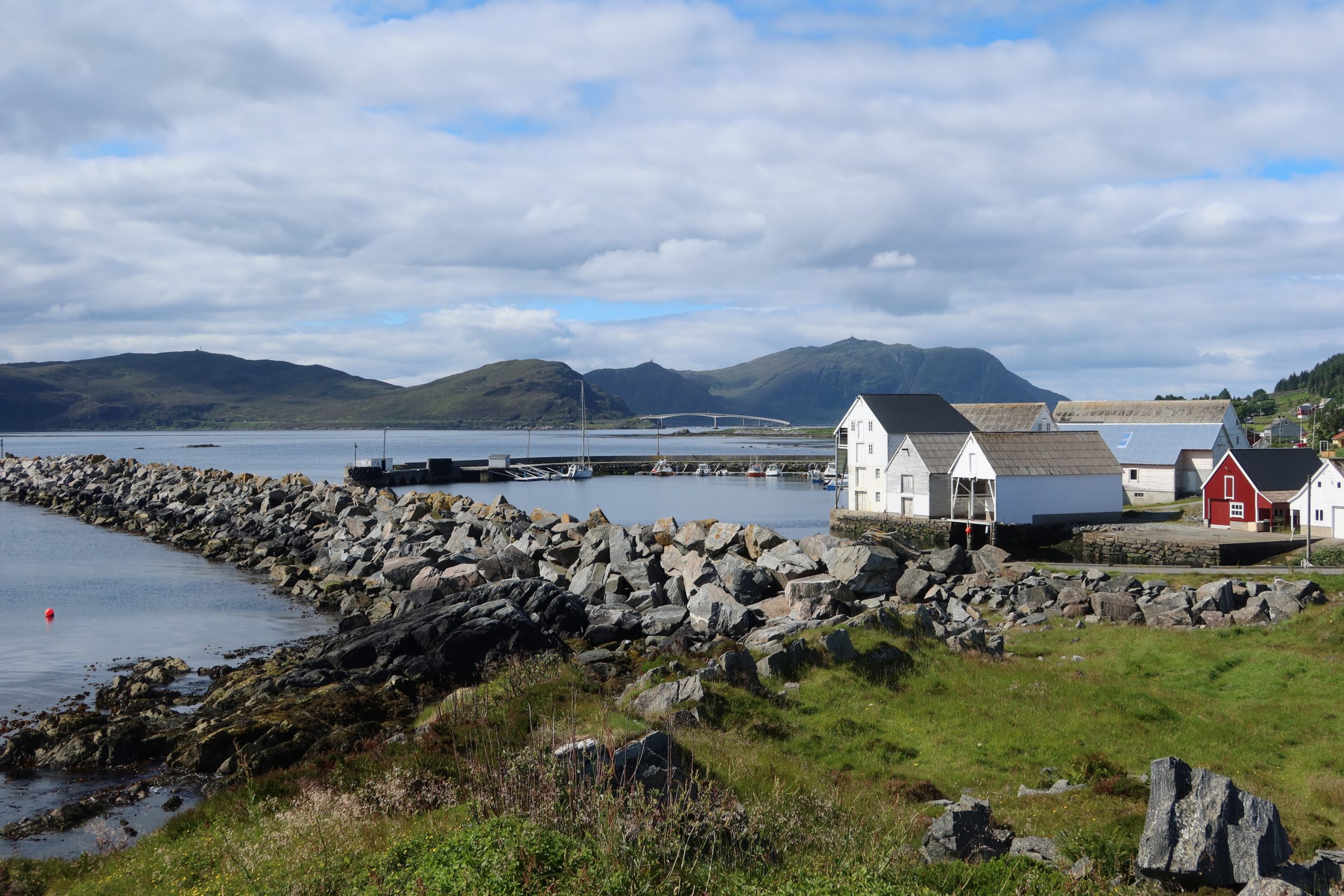
Fortunately for Pietro and his companions the island was used by farmers from the nearby Island of Røst. The battered sailors were fed and looked after and transported on the next trade ship back to Bergen where they were left with a parting gift by their hosts from Lofoten: sixty stockfish which Pietro would carry back with him to Venice.
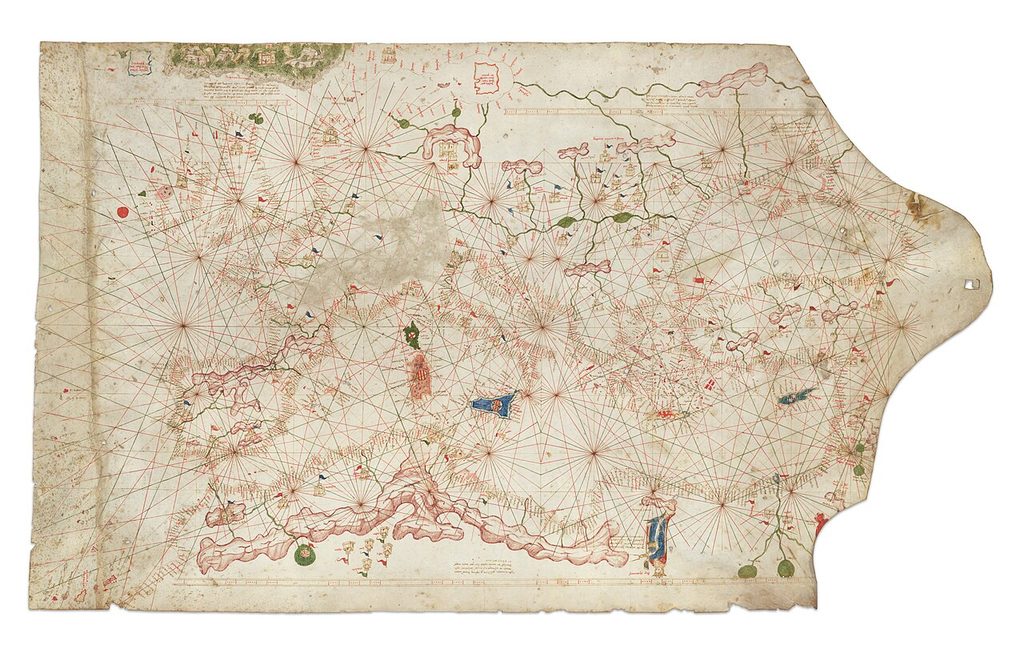
Pietro’s journey from Bergen to Venice – via Kings Lynn, Cambridge and London – is another story. Suffice it to say that he returned safely to his home city with an incredible tale to tell and a sack full of fish. His arrival in Venice must have been front page news. The great and the good presumably took Pietro’s stockfish to their kitchens, added some Mediterranean ingredients and a pinch of Italian culinary flair.
And that ladies and gentlemen is the official explanation for Italy’s love of Stockfish.
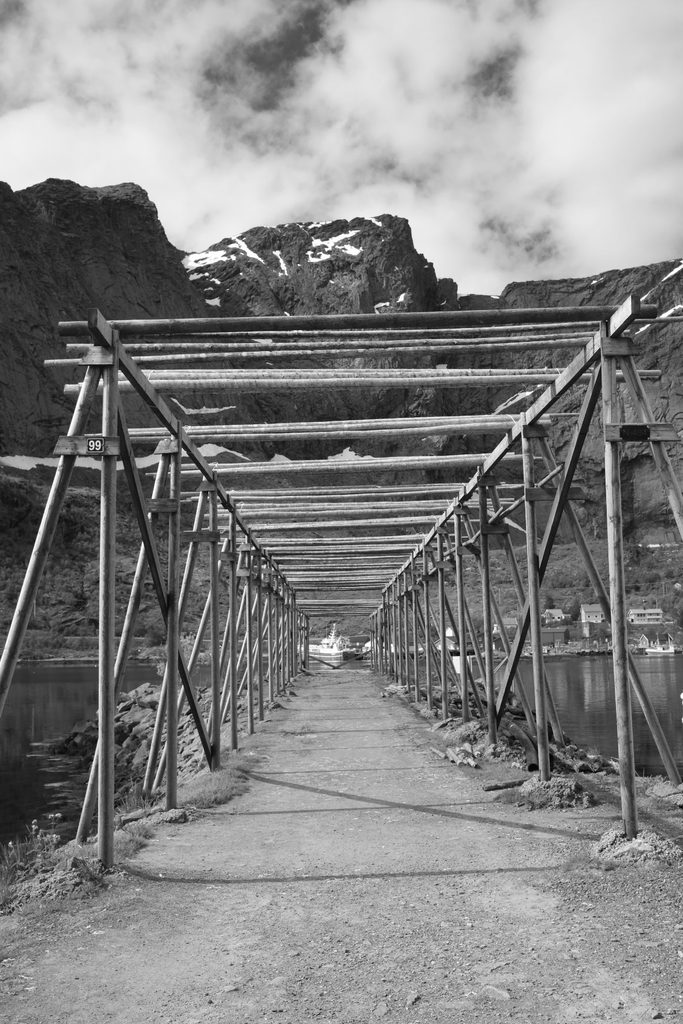
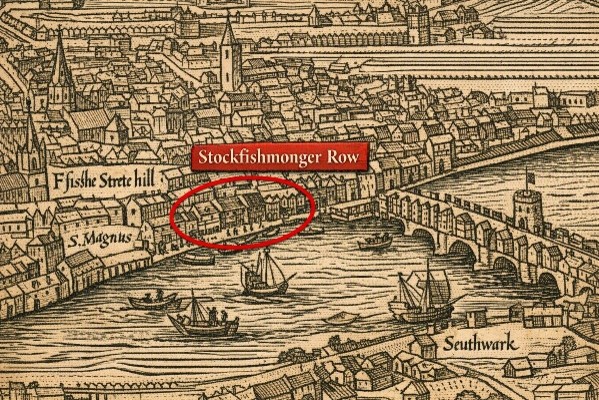
But is the official version true? Maybe. Commercial production of stockfish in Norway can be traced back three hundred years before Pietro was born. England was a likely importer of stockfish from at least the thirteenth century. The Oxford English Dictionary records the first use of the word ‘stockfish’ from 1282. And sixty years before Pietro’s voyage there existed an entire street of stockfish sellers in London: Stockfishmonger Row, on Thames Street by the river and the wharves below London Bridge (between Fish Street Hill and Old Swan Lane). So there’s a fair chance that Venice was also consuming stockfish long before Pietro’s return. But the romantic myth certainly makes the better story.
In Italy, Pietro is mostly remembered as a providential adventurer and culinary culture-hero, not as a reckless merchant-captain. The Norwegians use the Querini myth to cement the lucrative trade relationship between Italy and Norway (Norway has an official stockfish ambassador in Italy). There is little interest in digging up the real Pietro and questions about his seamanship or his ethics.
A feature of Pietro’s travelogue is his frequent praying to God. Whatever we think about Pietro’s faith, it certainly gave him the fortitude to keep going and remain optimistic in the face of desperate circumstances. Pietro says almost as much in his account: ‘Those who place all their hope in this famed fortune should not be blamed. But more effective is to declare the prior miraculous aids that the most merciful Lord God granted to my unworthy self and to ten others who were part of the group.’ Follow fortune if you like, but following God is the more pragmatic course.
On return to Venice, Pietro decided to go into politics. He embarked on his political career and sat on the Venetian senate for several years. His fame must surely have helped him get elected. And presumably he managed to present his chaotic and catastrophic voyage as a tale of daring Venetian exploration, and position himself as the hero of the piece.
We’ll never know whether Pietro made any of the pilgrimages or charitable acts that he solemnly promised God on his knees in the Cathedral at Santiago, in his private quarters, and again publicly on the sinking deck of the Cocco Querina. What we do know is that after his return he started calling himself the ‘Magnificent Master’ and wrote a book about his adventure called The Voyage of the Magnificent Master Pier Quirino, Venetian Gentleman.
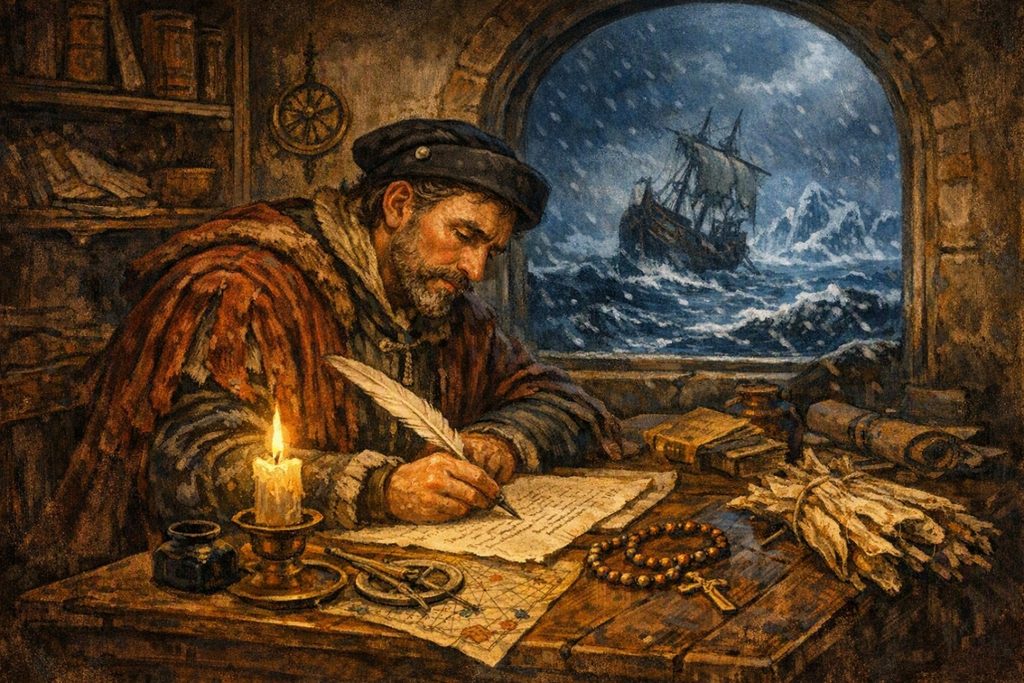
Yes, Pietro undoubtedly brought a package of stockfish back to Venice, and has left the world with an astonishing story. But his voyage was surely vain and irresponsible, and he made serious misjudgements at sea. By any estimation ‘magnificent’ was a generous title, given the circumstances.
Hugh Rayment-Pickard